
All County employees are covered by the Non-Punitive Discipline Program. The Sheriff’s Office reserves the right to impose unpaid suspensions on sworn law enforcement employees when warranted.
Overview of Traditional Discipline Program
The County practices the concept of progressive discipline. When an employee’s conduct warrants corrective action, the supervisor/manager takes the lowest level of disciplinary action which: 1) is appropriate to the severity of the employee’s offense; and 2) is likely to result in the employee not repeating the misconduct.
Under a traditional discipline program, minor misconduct (e.g., initial instances of tardiness or absenteeism) is normally dealt with through counseling confirmed in writing. Should the misconduct be repeated, the normal progression is a letter of reprimand followed by a suspension. Further misconduct may result in a second suspension, demotion, or dismissal. Misconduct of a more serious nature may result in suspension, demotion, or dismissal on the first offense.
The Non-Punitive Discipline Program follows the same steps as a traditional program with one exception – unpaid suspensions are replaced by disciplinary letters that equate to a suspension of a specified number of days. Non-Punitive Discipline is not a lower level of discipline than a suspension and does not include the option to suspend rather than issuing a non-punitive disciplinary letter. This provision was put into place to avoid disparate treatment (i.e. suspending one employee and issuing another employee who committed the same offense a non-punitive disciplinary letter).
The non-punitive disciplinary letter carries the same weight as a corresponding suspension. An arbitrator hearing a grievance on a subsequent offense for an employee who had previously been issued a disciplinary letter equating to a 3-day suspension must consider the employee to have been suspended for 3 days. Since non-punitive discipline carries the same weight and equates to an unpaid suspension, the burden of proof to show cause is also the same. In other words, the manager/department must be prepared to produce the same level of proof before the Civil Service Commission or an arbitrator as if the employee had been suspended.
Objectives of the Non-Punitive Discipline Program
The overall goal of the Non-Punitive Discipline Program is to improve public service and productivity in the workplace by:
- Correcting conduct problems promptly, rationally and constructively
- Alleviating the financial impact of discipline on employees’ families
- The employee remains working during the suspension, so the department is not impacted by the suspension by having to cover that workload
- Taking disciplinary action, which is just, equitable and sustainable
Non-Punitive Discipline Program Overview
The Non-Punitive Discipline Program replaces unpaid suspensions with a disciplinary letter which fully equates to a suspension of a specified length (e.g., one day, three days, etc.) and the Union agrees and acknowledges that the disciplinary letter carries the full weight of such a suspension for the purposes of establishing progressive discipline. This process eliminates the financial impact of a suspension on the employee and the employee’s family while still establishing a record of progressive discipline should the offense recur. This process also eliminates the need for the department to replace the employee during the suspension, thereby conserving County funds.
Employees retain the right to appeal non-punitive discipline through the grievance process or to the Civil Service Commission.
How the Non-Punitive Discipline Program Works
The Non-Punitive Discipline Program is designed to help correct conduct and attendance problems by serving as a step in progressive discipline. Normally, the Non-Punitive Discipline Program will not be used to correct performance problems (quantity/quality of work). Performance problems are dealt with through counseling, corrective action plans with performance-specific objectives and outcomes, and performance evaluations.
Investigation – When an incident of misconduct or an attendance problem has been investigated and it is found that more likely than not unacceptable behavior occurred, the department confers with Employee & Labor Relations and makes a determination regarding the appropriate level of discipline. If it is determined that the infraction does not warrant demotion or dismissal but does warrant more than counseling or a letter of reprimand, the non‑punitive discipline program will be used.
Intent Letter – A Skelly Letter of Intent is issued to the employee stating that it is the intent of the department to issue a disciplinary letter equating to a suspension of a specific number of days. This letter takes the same form as the usual Skelly letter but, instead of proposing a suspension, proposes a disciplinary letter equating to a suspension. Please see Sample Intent Letter – Non-Punitive Discipline.
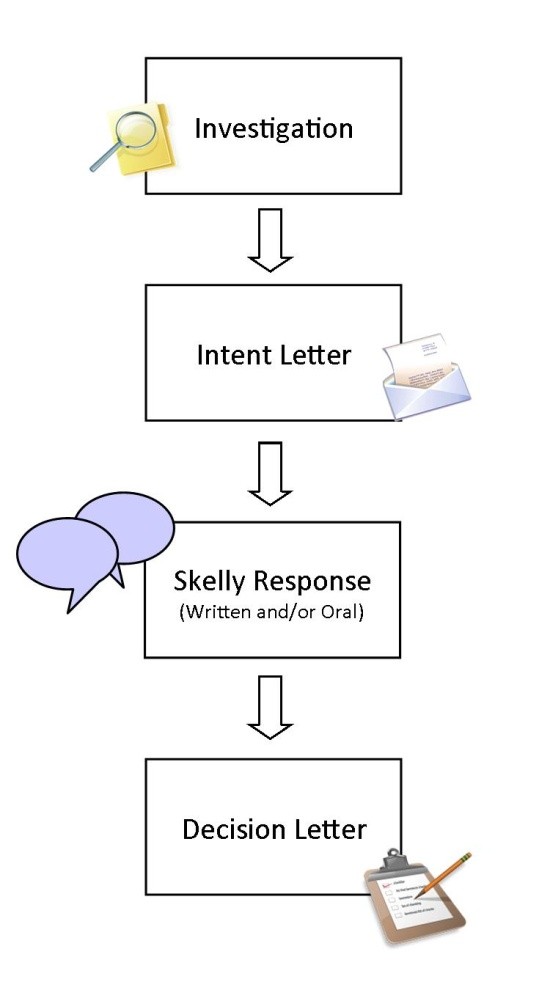
Oral/Written Response – The normal Skelly process is followed, with the employee having the opportunity to make an oral and/or written response to the charges in the Intent Letter.
- If the employee presents information which causes the department decision maker to determine that the disciplinary letter is not warranted, the case will be closed with a letter of reprimand, a warning letter, or a letter clearing the employee of the charges, as appropriate.
- If the department decision maker determines that the disciplinary letter is warranted, they will issue a decision letter, imposing the disciplinary letter in lieu of a suspension. As in other disciplinary actions, the department decision maker may decide to modify the proposed discipline (e.g. a letter equivalent to a 1-day suspension rather than one equivalent to a 3-day suspension) based on the employee’s response. Please see Sample Decision Letter – Non-Punitive Discipline.
The management official hearing the oral response determines, based on the employee’s response and by asking questions, whether the employee acknowledges that the misconduct for which they are being disciplined was improper, and whether it is the employee’s intent not to repeat the misconduct.
- In some instances, such as an isolated incident where training, counseling or other actions are likely to permanently resolve the issue, if the employee acknowledges that their misconduct was improper, and indicates the intent not to repeat the misconduct, a rehabilitation plan is developed. This plan will list actions the employee will take and/or training the employee will attend to ensure that the misconduct does not recur. The plan will also set a timeframe during which misconduct must not recur. Once the actions laid out in the rehabilitation plan are completed and the agreed upon timeframe has elapsed without further misconduct, the disciplinary letter will be removed from the employee’s personnel files. At this point, the matter will be closed, and the employee will be considered fully rehabilitated.
- If the employee does not acknowledge that their misconduct was improper, and/or does not indicate the intent not to repeat the misconduct, no rehabilitation plan will be developed, and the letter will remain in the employee’s personnel files.